Leaks, corrosion, and freeze damage
Arvada pipe repair that starts with finding the cause.
Rusted supply lines, copper pinholes, hidden leaks behind drywall or under slab, and split hose bibbs after a cold snap. One master plumber traces the problem, then fixes it so you are not calling back in six months.
A town built across sixty years of plumbing code
The pipe under an Arvada house depends on the decade it went up.
Arvada spreads northwest of Denver across two counties, and the neighborhoods came in waves. What is in your walls has more to do with the year the foundation was poured than with the street you live on.
The postwar and mid-century blocks are where we still find galvanized steel supply. That pipe does not usually announce itself with a puddle. It rusts inward, the opening narrows a little every year, and the first thing anyone notices is that the shower goes weak when the washer runs. Homeowners often chase that as a pressure problem and put a new fixture on a pipe that has almost closed. Call (303) 883-9075 or contact us and we will look at the line itself before anyone buys parts.
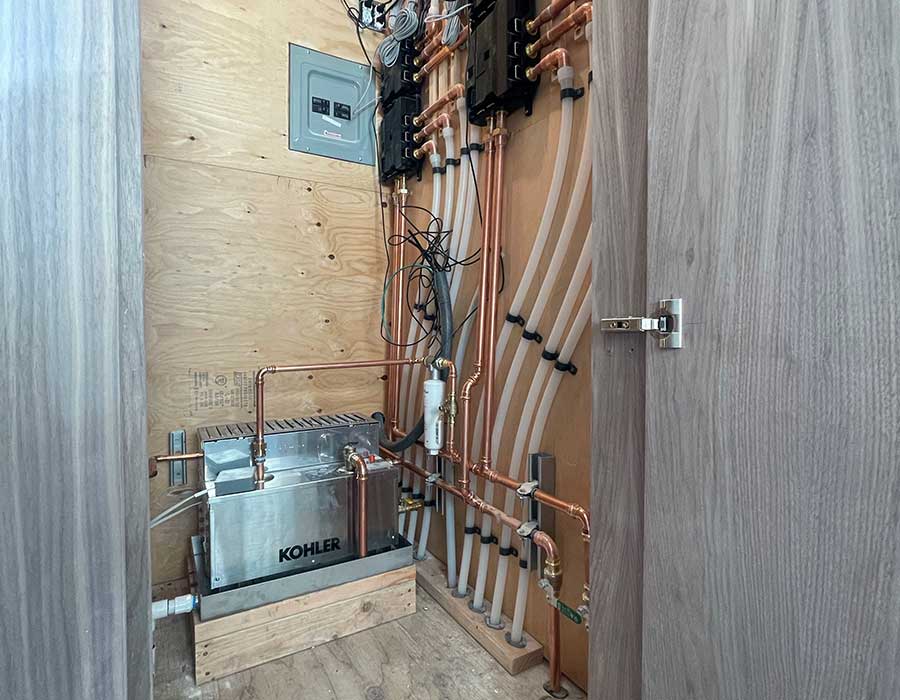
Homes from certain build eras carry polybutylene instead, a gray flexible supply line that was popular for a stretch and has a reputation for failing at the fittings. Newer construction out on the north and west edges of town is copper and PEX, which buys you decades but does not make a house immune. Any of it can be damaged by a hard freeze, a nail from a remodel, or a shifting foundation. See our gallery for how we leave a job.
- Galvanized Supply Replacement
- Copper Pinhole Repair
- Polybutylene Line Replacement
- In-Wall Leak Location
- Slab Leak Repair
- Whole-House Repipe
Weak pressure is a symptom, not a diagnosis
What low water pressure is usually telling you.
A house that has lost pressure gradually over a decade is rarely a pressure problem at all. It is a diameter problem. Rust builds on the inside wall of galvanized pipe until the opening is a fraction of what it started as, and the effect stacks up over a long horizontal run. The upstairs bathroom goes first because it is farthest from the meter.
There is a second cause worth ruling out before anyone opens a wall. Front Range homes typically run through a pressure regulator, and those wear out. When one fails it can drop pressure across the whole house or, worse, let pressure climb high enough to stress every fitting and appliance connection you own. Checking the regulator is a short job. Replacing supply lines is not. We check the cheap thing first, and the point of the visit is to tell you which of those it actually is. Call (303) 883-9075 or contact us.
- Pressure testing at the meter
- Regulator inspection and replacement
- Fixture and stop valve checks
- Hot side and cold side comparison
- Corrosion assessment on old runs
- Repair or repipe recommendation
Finding it before opening anything
Locating a leak you cannot see.
The leaks that worry people are the ones with no visible water. A water bill that jumped for no reason, a warm patch on a basement floor, a musty smell in a closet, a meter that keeps creeping with every fixture shut off. Those are all real signals, and none of them tell you where the pipe is.
We isolate the system section by section and use listening and thermal equipment to narrow the location before any drywall or concrete comes out. That matters most on a slab leak, where guessing wrong means cutting a hole for nothing. It matters almost as much in a finished basement, where the difference between a precise opening and an exploratory one is the whole cost of the repair.
Once we know where it is, the honest conversation is whether to open the floor at all. On a lot of Arvada homes, rerouting the affected line overhead or through an adjacent wall is faster, less destructive, and lasts longer than breaking into the slab to splice a fitting that will sit in damp fill the rest of its life. We lay out both routes. Call (303) 883-9075 or contact us, and see our pipe repair service page for how we handle this across the metro.
One patch, or the whole run
When spot repair is honest and when it is not.
A single copper pinhole on an otherwise sound system is a spot repair, and anyone who tells you differently is selling. We cut out the failed section, solder in fresh pipe, and pressure test it. Pinholes happen where water chemistry, velocity, and a slightly rough interior meet, and the hot side tends to go first because heat speeds the reaction.
The math changes when the same house leaks again somewhere else a few months later. Repeated small leaks in different rooms are almost never coincidence. They mean the run has reached the end of its life and you are paying to chase it one fitting at a time. That is the point where a repipe stops being the expensive option and starts being the cheaper one, and we will say so plainly rather than book another patch. Take a look at our Arvada work or reach us through the contact page.
Cold snaps and the parts nobody exercises
What a Colorado winter finds first.
Freeze damage is not random. It shows up in the same places every year: supply lines run through an uninsulated exterior wall, pipe in a garage or an unheated crawl space, and outdoor hose bibbs left with a hose attached in the fall. The split forms while the water is frozen, and the water does not come out until it thaws, which is why a burst so often announces itself on the first warm afternoon.
Winter also exposes the shutoff valve nobody has touched in thirty years. A main shutoff that has sat in one position since the house was built often will not close when you finally need it. Knowing your main works, and being able to reach it, is the difference between a wet floor and a wet floor plus a ceiling.
If a pipe has already burst, shut the main off first and call after. Stopping the flow is what limits the damage while we get there. Call (303) 883-9075 day or night.
- Exterior wall line repair
- Hose bibb replacement
- Safe thawing and inspection
- Crawl space and garage runs
- Main shutoff replacement
- Pipe insulation before winter
How a repair call runs
Find it, fix it, prove it holds.
Trace the Source
Isolate the system, read the meter, and use detection equipment to narrow a hidden leak to a spot before anything is opened.
Repair or Reroute
Section repair where the rest of the run is sound. Reroute or repipe where the pipe itself is the problem, with the reasoning laid out first.
Test and Close Up
Pressure test the repair, check flow at the fixtures, and patch back what we opened. Wes is a licensed GC, so the wall is our job too.
Straight answers
Pipe questions we hear around Arvada.
My water pressure has dropped everywhere in the house. Is that a pipe problem?
Usually, but not always. If the drop came on slowly over years, corroded galvanized supply is the likely cause, since rust narrows the pipe from the inside. If it happened suddenly, a failing pressure regulator is more likely and much cheaper to fix. We check the regulator before recommending any pipe work. Call (303) 883-9075.
How do you find a leak under the slab without tearing up the floor?
We isolate the system and use listening and thermal equipment to narrow the location down before anything is opened. That way any cut we make is small and in the right place. On a lot of homes rerouting the line above the slab turns out to be the better repair than breaking concrete, and we will walk you through both options.
I have had three small leaks in two years. Should I just keep repairing them?
Probably not. Repeated leaks in different spots mean the run has reached the end of its service life, and patching it one fitting at a time costs more over a couple of years than doing it once. We will tell you plainly which situation you are in instead of booking another patch. Call (303) 883-9075 or contact us.
A pipe burst after a cold night. What do I do right now?
Shut off the main water supply first, then call. Stopping the flow is what keeps the damage from spreading while we are on the way. Freeze splits usually show up in exterior walls, garages, crawl spaces, and outdoor hose bibbs, and the water often does not appear until the pipe thaws.
Do you replace polybutylene supply lines?
Yes. Homes from certain build eras have gray flexible supply line that has a reputation for failing at the fittings. We replace it with PEX or copper depending on the house, plan the runs to stay out of unheated space where we can, and pressure test the system before we call it finished.
Leaking pipe in Arvada?
Call and we will find the cause, tell you what it really needs, and fix it once.
While the wall is open it is worth knowing what else runs through it. If the trouble started as a slow drain rather than a pressure problem, that is drain cleaning, and if it is out under the yard it is sewer work. Old supply pipe usually turns up alongside an aging heater, so water heater installation often lands in the same visit, and a repipe is far cheaper to do while a bathroom remodel already has the walls apart.